

“We’ll have to discuss our options,” the doctor continued.
“Options?” I ventured, adjusting my mask.
That’s when my wife began to cry. She didn’t stop for a month, I don’t think. As for me, I felt terrible because I didn’t feel terrible. Motherhood, I believe, commences immediately, with the first recognition of life’s bud, but fatherhood is slow to start. At no point did I feel like a father, truth be told. Maybe this deficiency was unavoidable. My parents divorced when I was little. Dad went to Amsterdam. Mom said he had business there, but later I learned that he was simply making a name for himself dancing burlesque. That was in the Eighties, before we became as virtuous — that is to say, as tolerant — as we are today.
Anyway, I grew up doubting my paternal capacities. But I’d been willing to give fatherhood a shot, if only for my wife’s sake. She’s one of those women who grew up imagining herself a mother. As a girl doing ballet in tights, she was a mother. As a teenager dancing at mixers with a bare midriff, she was a mother. As a student clicking away on her MacBook in the stacks, she was a mother. As a bride drinking champagne on the steps of the Episcopal church, she was a mother. And then she actually was a mother, until she wasn’t. But as for me, I was never a father, and I suppose she eventually saw that, as she groaned in our bedroom while I went on living life for the both of us.
When she quit crying, she was a different person, as if she’d passed her soul through her tear ducts and grown a new one in her evacuated uterus. The shifts in habit were subtle, then glaring. Where once she liked to go out on Saturday evening, now she insisted on staying home and fiddling with recipes gleaned from the NYT Cooking app. Where once her Netflix queue was full of Nordic police procedurals, now it was full of Millennial sitcoms. Where once she was dimly conscious of politics, now she aired her opinions across Twitter in a most brazen and ornery manner. People are disproportionately defined by the small things: the flush of her countenance and the shape of her mouth began to change, until one morning I lunged from bed in fright, believing a stranger had made her way between the sheets.
On our last night together, I came into the bathroom as she stepped out of the shower. She blushed and turned away, ashamed, and I fumblingly tossed her a towel. Next day, she told me that she was going to Boston to see her sister. I asked if she’d be alright traveling by herself. She looked at me with an unsettling admixture of sorrow and contempt. I was determined to give her space. I’m a modern husband, you know. Liddy (the sister) FaceTimed me a week later. Six years and nothing but a secondhand farewell.
After Labor Day, I took a puddle jumper to the island. How weird, suspended between sea and sun, neither here nor there, but somewhere else altogether. The pilot looked at me over his shoulder, grinning delightedly through a fantastic mustache. He must’ve been a veteran aeronaut, judging by his easy demeanor and evident facility with the controls, and I would’ve thought he’d be accustomed to the lofty and expansive vision, even bored by it. But some things you never get used to.
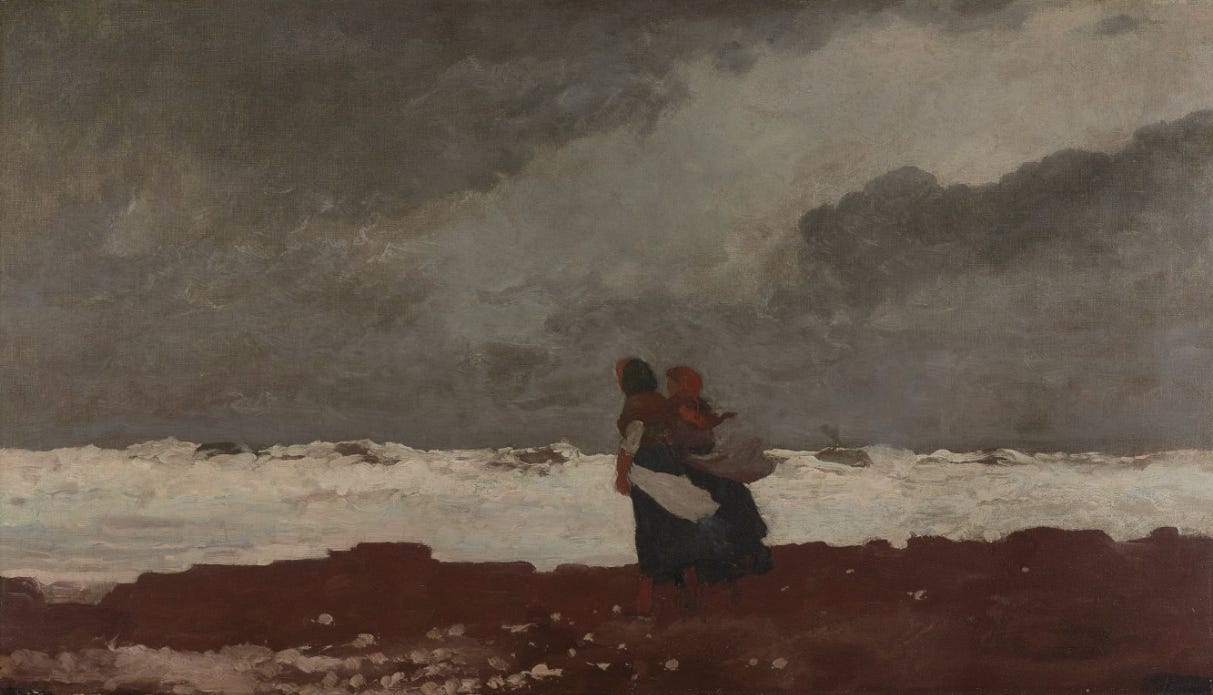
I’d booked an open-end reservation at an inn near the salt marsh. My wife was gone, and I hadn’t been to the office since the pandemic kicked off, so I expected to tarry a while. The hostess gave me gingerbread when I checked in. Wine and cheese, she said, would be set out at five o’clock. I spent the morning Skyping with a client in Hartford. It was afternoon when I finished. The hostess had left a pile of ham sandwiches in the fridge. I wrapped one in tinfoil and headed down to the beach with a towel over my shoulder. I’d felt estranged up to that point, but the sight of grassy dunes lifted my spirits. It was a typical post-Labor Day scene. A few leathery dames in one piece bathing suits; a smattering of families bivouacked under colorful umbrellas. I sat down in the sand, shirt off, face tilted toward the sun. I knew that the water would be warm — it’s warmest in autumn — but I didn’t care to swim. The ocean, with its boundless compass and unfathomable depths, struck me as a seething entity with designs upon my person. I couldn’t help but imagine it as a murky womb astir with life of probable ferocity and rapacious appetite. If I ventured into the sea, what might happen? Would I lose something of myself? How much might it steal from me? I tried to eat my sandwich, but the pinkish hue of the deli meat made me queasy.
I turned my back to the sea and went to a pub on Main Street. By the time I paid my tab, the sun was simmering in the west, half-submerged. It was that uncanny hour of dusk characterized by an odd coincidence of finality and possibility, when the deeds of the day, good and evil alike, are assigned irretrievably to the judgment of history, while the eventualities of the night begin to coyly suggest the means of their realization. That hour is electric with revelation and, as I walked to my room, I felt reconciled to the vicissitudes of the human position.
Next morn, I woke to the dawn light feeling rested but vaguely disjointed, as if I’d received news of ambiguous significance. I contemplated texting my wife. To what end, though? Instead, I opted to put some hours into a deal that’d been languishing on my agenda since winter. My practice is modest but turns a nice buck. Most of my clients are family enterprises captained by shrewd patriarchs and their avaricious but commercially inept progeny. Such endeavors are rife with the perils and intrigues of the domestic milieu. I do the best I can, no more.
Lunch was on the veranda. I joined a couple of Quebeckers who were gleefully besmirching the intelligence of American voters.
“They reverence this buffoon,” the wife hissed between mouthfuls of chicken kale salad.
“It is nightmare, yes?” asked the husband, patting my knee.
“Oh, yes,” I answered.
Convinced at a young age of the benefits of sociability, I feigned compunction, sighing at the stupidity of my compatriots. When the wine was done, I excused myself with abundant apologies. The Quebeckers whispered bitterly in French as I withdrew. I was seized by the desire to run, to fly away, to take solace in a cramped and hidden place, but I maintained composure and, grinning feebly, retired to my quarters.
The room was silent. I hovered by the eastern window, waiting, studying the landscape. Beyond the sandy lawn the mazarine sea was placid, ancient: our common mother. A black Labrador trotted down the beach. An old lady in a yellow swimming cap made her way through the dunes toward a neighboring inn. Overhead a plane banked noiselessly in the soft September light. I heard the Quebeckers coming inside, their voices muffled. The moment seemed to offer secret knowledge. I was sure, absolutely sure, that some obscure glory shone all around. The possibility of missing such awful radiance made me dizzy with fear. Overcome by this gnostical insight, I ran to the toilet and vomited.
Squaring myself away, I took a cab to the northern tip of the island, where Hollis has a gauche glass-and-steel mansion perched on a bluff above a private beach. He greeted me at the door appearing gaunt and tan, as if he’d spent the summer doing narcotics poolside. Which, likely, he had. It’d be an exaggeration to call Hollis a friend, but we’d enjoyed an easy acquaintanceship since sharing a dorm at Amherst. After college, he promoted a string of forgettable garage rock bands before making a fortune in early stage crypto, essentially by accident. But money only exacerbated a native insecurity, and as he showed me around the garish estate, he earnestly sought my approval of this fixture and that bauble, which approval I indulgently supplied. We terminated our tour in the kitchen, where he extolled the refrigerator’s high definition display screen. Then, throwing up his hands as if to gesture at the totality of things, he sighed, “Maybe I went overboard. I dunno. Anyway, what’s going on with you?” I related recent events, to which he replied with a genuinely philosophical tone: “That’s messed up.”
We tried some squash, but I guess he’d done some Xanax, so we sat on the patio and watched the outdoor flat screen. It was late afternoon. Beyond the nearby bluffs, over the gently stirring sea, gulls wheeled and dove. I scrolled absently through the photos on my phone. Paused: my wife, sitting on a dock at Bar Harbor, squinting through the blaze of evening crimson, head cocked, mouth agape, as if in mid-sentence. She looked careless, naive, fertile. I tried to retrace my steps to that very second. Where had it gone?
Hollis yawned and tapped at his phone. “Hey, Eleanor’s looking to come by,” he said.
“Oh?” I asked coolly.
He pushed down his sunglasses. “Her girls, too. One of them, this chick, has like a million followers. Crazy, right? I think I’ve seen her stuff.”
“I didn’t know Eleanor was around,” I said evenly.
“Sure she’s around,” Hollis laughed.
Eleanor and I had dated in our mid-twenties. Freshly graduated, I was bored and unemployed after a brief stint with the Obama campaign, expending myself on trivialities, reluctant to step into adulthood. Eleanor was a curiosity: waifish, spacy, a scenester with a degree in “visual culture.” The attraction was instant, but soon I discovered that she required much handling.
What I first took for bohemian quirkiness I soon found to be a cast of personality bordering on the spooky. She rarely ate, kept a highly irregular sleep schedule, maintained no fewer than three Twitter alts, and derailed conversations with oracular pronouncements. Her moods were entirely unpredictable, her demeanor affected, her motions spastic. To say nothing about her – shall we say? – private eccentricities, the fruit of premature exposure to AOL chatrooms. We cared a lot for each other, but I’m basically a normal guy. In any event, she accepted the end of our relationship without a fuss, and I hadn’t seen her for a decade-ish, save for the occasional peek at her Insta.
I felt another wave of dizziness. Hollis conducted me to a guest room where I quickly fell asleep. Hours must’ve passed. When I came to, a lanky figure sat cross-legged at the foot of the bed: Eleanor.
“Tired boy,” she burbled.
I sat up and rubbed my face, croaking a salutation, terrified by her peculiar vibrations. In the faint light, I could make out her enormous glistening eyes and feline mien. My heart began to race.
She took my hand, led me downstairs, through the kitchen, and onto the patio, where Hollis sat with a dozen kids I didn’t recognize, laughing and drinking around the firepit. No one paid us any notice as we passed by. Then we crossed the damp lawn and descended a flight of rotting wood stairs to a crescent of sand and gravel wedged between towering clay cliffs and the black and boundless water.
Suddenly, she danced and leapt, crying, “See! See!” I looked up. Meteors with long milky tails rained overhead: flickering, flaming, dissolving forever.
“That’s something,” I admitted.
She stretched forth her spindly arms to the infinite vault of night. Like an aboriginal prophetess, she exclaimed in a sing-song voice, “O ages of ages!”
Then all things above and below – all things on earth and in heaven – became vivid, prominent, crystalline. I was overwhelmed by the magnitude and transparency of the universe and the sheer gratuitousness of life. Strange grace! I reached for Eleanor’s hand, trying to find my balance, to feel the reassuring solidity of human flesh. But already she’d slipped off her gingham dress and plunged into the Atlantic. I looked again at the vast panorama of form and emptiness. Instantly, I knew about death and the death of death, about life and life upon life. By some precious gift from above, I saw all things outstanding and reverberant. The sickness in my heart transmuted into tenderness and mercy, and when I looked upon the world, I saw nothing unbecoming.
How I wished to talk to my wife, to tell her what I’d glimpsed! I reckoned that she was in bed, sleepy and alone, reading her Kindle. And the child. Where was it – my child? I perceived then that no space separated us, and that everything dwells in and returns to the unmoving fire that sweetly moves the spheres. Still, I yearned to touch them, mother and child both: to illumine them, to draw them to my breast, to compensate for my failures as a husband and father with one pure embrace. But I knew with divine certainty that this embrace would have to be deferred, until I became patient and mellow through suffering.
Ah! Yes, there was Eleanor, too. Calling from the sea. . . . It’s an admirable thing to swim chastely under the moon. It softens life’s cruelties. It fills the soul with peace. And it washes you clean again, so that you’re innocent, as in the beginning.
Philip Primeau writes from Connecticut. His work has appeared in Crisis, Catholic World Report, and Homiletic & Pastoral Review, among other places. He publishes regularly at his Substack, Gladsome Light (gladsomelight.substack.com). He can be contacted at primeau.philip1@gmail.com.